

Spiro Unveils Electric Motorcycle Designed for Rwanda’s “Land of a Thousand Hills”

KIGALI, Aug. 14, 2026 — Rwanda’s mountainous terrain is becoming a key testing ground for the country’s shift toward electric mobility, with motorcycle manufacturer Spiro unveiling a new model designed to handle steep slopes, rough roads and the demands of daily commercial riders.
Spiro Rwanda introduced the EKON 450 M1 V3 on Friday at its stand at the International Trade Fair in Gikondo, Kigali, describing it as a motorcycle developed specifically with Rwanda’s road conditions and riders’ needs in mind.
The launch comes as Rwanda seeks to expand electric transportation and reduce reliance on fossil-fuel-powered vehicles. Motorcycles are particularly important to Rwanda’s urban transport system, where thousands of commercial riders depend on them for their livelihoods.
Spiro says the new model is built to provide greater stability and control on Rwanda’s hilly and uneven roads. It features durable tires, a comfortable riding position and an improved braking system intended to help riders manage steep climbs and descents.
Annet Dengeri, Senior HR Officer at Spiro Rwanda, said the EKON 450 M1 V3 represents another stage in the company’s development since it began operating in Rwanda in 2022.
“This is the eighth motorcycle version that Spiro has introduced since we started operations in Rwanda,” Dengeri said.
She said the motorcycle incorporates newer technology while responding to conditions riders encounter on a daily basis.
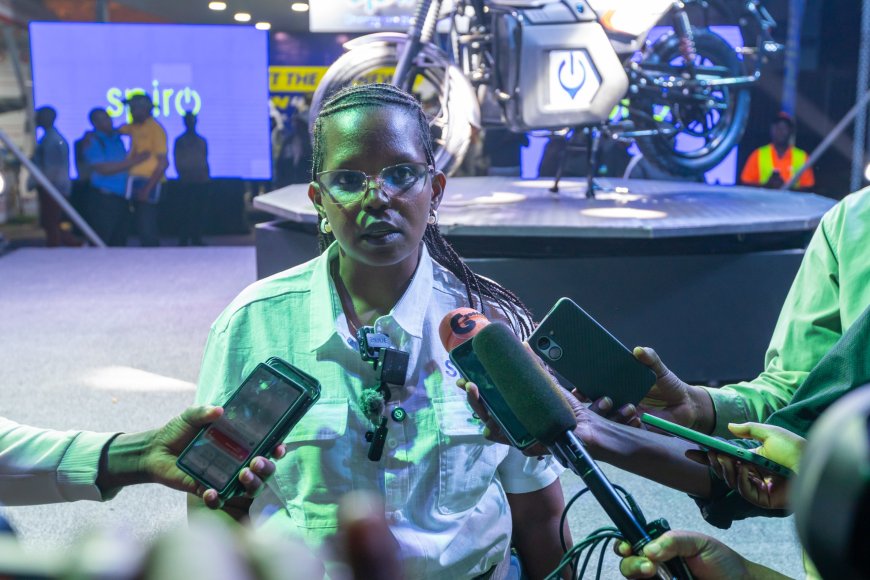
The company has also focused on braking and motor performance, which Dengeri said are particularly important when riding on steep roads.
For motorcycle taxi operators, ground clearance and stability can make a significant difference when navigating potholes and poorly maintained roads.
Mfashwenimana Amiel, one of the riders who tested the motorcycle, said its design gives it an advantage on difficult roads.
“With other motorcycles, when you reach an uphill section or a rough road, the motorcycle can sometimes hit the ground. But the EKON M1 V3 has enough ground clearance, so even when you ride on roads with potholes, it does not hit the ground. That makes it suitable for our roads.”
Beyond the motorcycle itself, Spiro is trying to address another major challenge for electric motorcycle users: access to charged batteries and the time required to recharge them.
Dengeri said the company’s mega stations can handle between 300 and 800 batteries simultaneously, a capacity intended to reduce waiting times and improve access to battery charging or swapping services.
Spiro says it has invested in expanding electric-mobility infrastructure across Rwanda over the past three years, including charging and battery-swapping facilities. The company has recently introduced seven mega stations as part of that expansion.
The company also says the EKON 450 M1 V3 could reduce operating costs for riders, with users potentially saving up to 35% compared with comparable petrol motorcycles, while replacement parts could cost up to 40% less.
For Rwanda, where motorcycle taxis remain an important part of urban mobility, the success of electric motorcycles will depend not only on their environmental benefits but also on their ability to withstand local roads, remain affordable and provide reliable access to energy.
With the EKON 450 M1 V3, Spiro is betting that adapting electric motorcycles to Rwanda’s “Land of a Thousand Hills” can help accelerate the country’s transition to cleaner transport.


By Napoleon Mugenzi