

African Airlines Sustain Growth Despite Dip in Overall Capacity – AFRAA Report

Africa’s aviation industry continues to demonstrate resilience, with steady growth in passenger numbers and improved operational efficiency, according to the June 2025 performance update by the African Airlines Association (AFRAA). While total seat capacity across the continent dropped by 3% compared to June 2024, intra-African routes saw a modest 0.1% increase driven by new route launches, fleet upgrades, and network expansion.
Passenger Traffic Shows Resilience Amid Capacity Adjustments
While overall seat capacity across the continent dipped slightly in June 2025 compared to the same month in 2024, intra-African routes saw a marginal increase of 0.1%. AFRAA attributes this growth to the launch of new regional routes, strategic network expansions, and the deployment of larger aircraft.
The top ten African airports by seat capacity in June 2025 were:
Cairo International Airport (22.6%), Johannesburg O.R. Tambo International Airport (14.8%), Addis Ababa Bole International Airport (14.7%), Casablanca’s Mohammed V International Airport (8.9%), Houari Boumediene Airport, Algiers (7.4%), Cape Town International Airport (7.0%), Nairobi’s Jomo Kenyatta International Airport (6.7%), Marrakesh Menara Airport (6.6%), Tunis–Carthage International Airport (5.8%), Hurghada International Airport (5.3%)
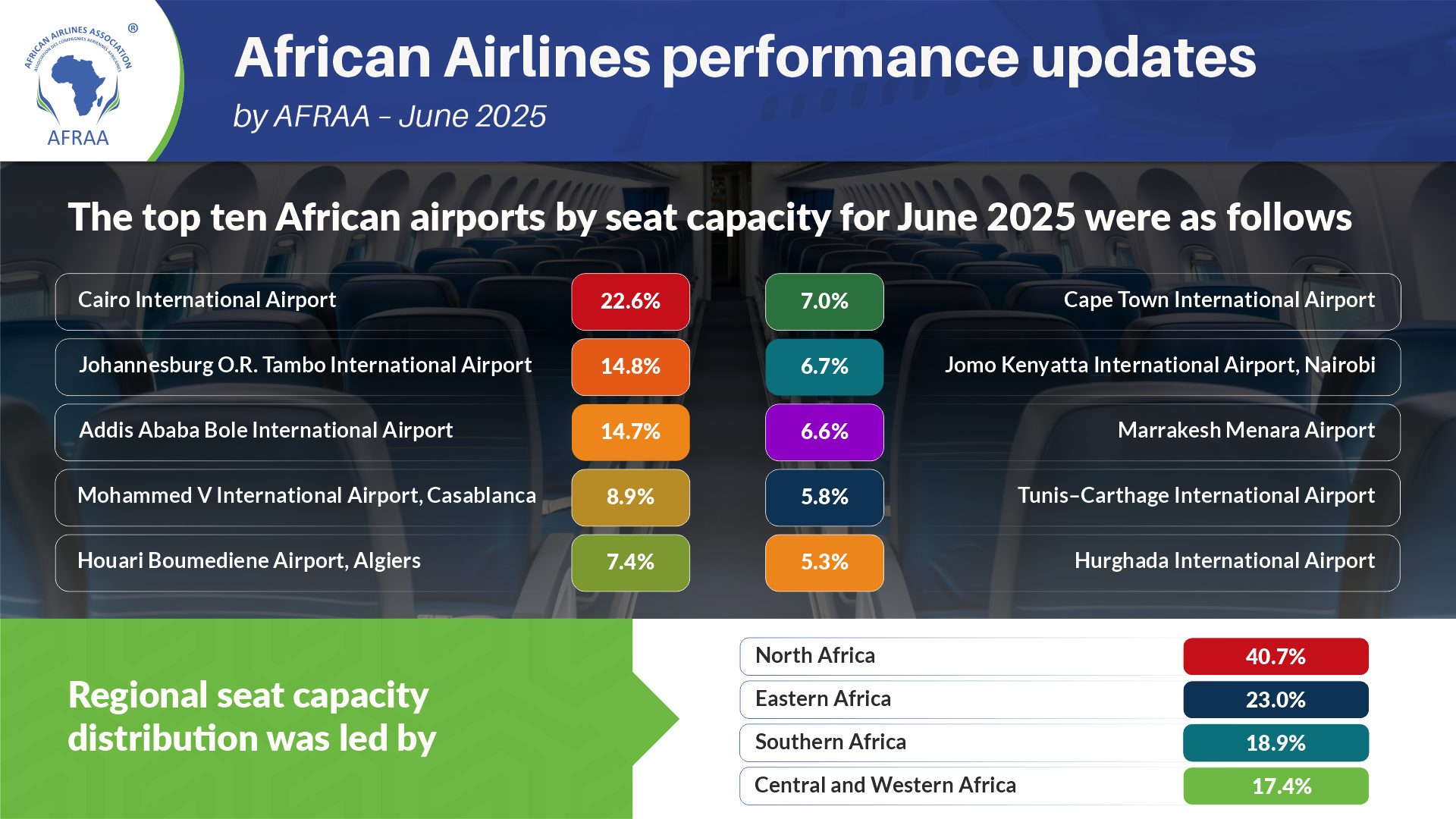
In terms of regional seat capacity distribution, North Africa led with 40.7%, followed by Eastern Africa at 23.0%, Southern Africa at 18.9%, and Central & Western Africa at 17.4%.
Key Performance Indicators: Growth in RPKs and Revenue
Passenger traffic indicators suggest continued momentum. Available Seat Kilometers (ASKs) rose by 2% in May 2025 compared to May 2024, while Revenue Passenger Kilometers (RPKs) increased by an estimated 6%. Between January and May 2025, RPKs jumped by 9.4%, reflecting stronger demand.
AFRAA forecasts that African carriers will transport 113 million passengers in 2025, up from 98 million in 2024 a 15.3% annual growth, highlighting the sector’s recovery from pandemic-era lows.
April 2025 saw a 19% year-on-year growth in passenger revenues, signaling rising consumer confidence and pricing resilience across markets.
Cargo Dynamics: Exports Leading, Eastern Africa Dominant
AFRAA’s analysis of cargo traffic as of May 2025 shows that exports outpaced imports in most regions. However, Southern, Central, and Western Africa recorded higher import volumes than exports. Eastern Africa emerged as the dominant cargo hub, accounting for 30% of Africa’s total cargo market.
Rising Jet Fuel Prices Add Operational Pressure
The global average price of jet fuel rose sharply to $96.97 per barrel by the week ending 20 June 2025 up 12.9% from $82.30 a month prior. This spike poses new cost challenges for airlines already navigating complex regulatory and market conditions.
International Market Share: African Carriers Hold Ground
As of April 2025, African carriers controlled 52.4% of international seat capacity, including regional and intercontinental routes. However, their share of intercontinental capacity was just 36.3%, with non-African airlines holding a dominant 63.7%.
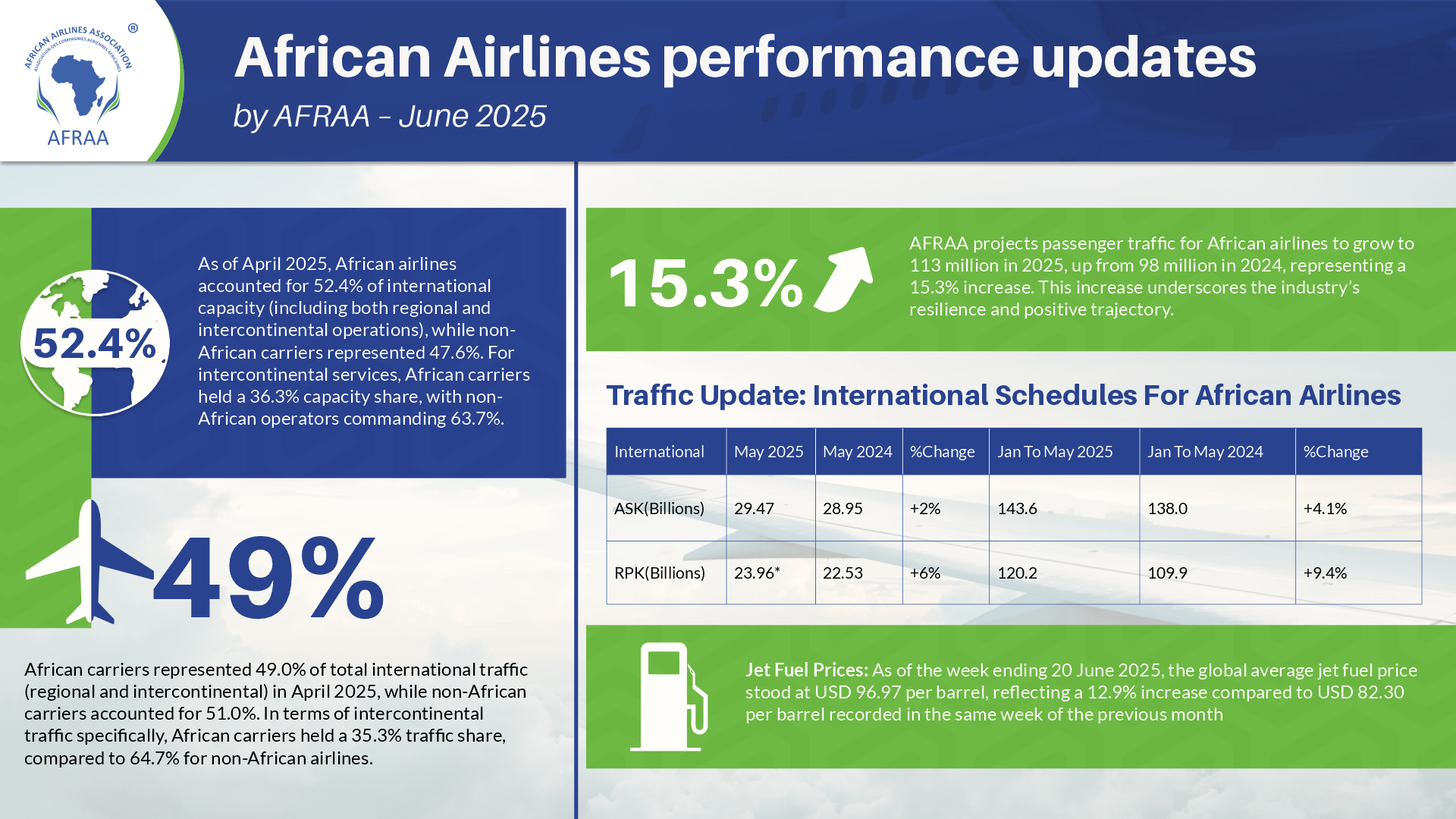
In terms of international passenger traffic, African airlines handled 49%, while non-African competitors accounted for 51%. The intercontinental traffic share stood at 35.3% for African carriers, compared to 64.7% for non-African counterparts.
Regulatory Landscape Shifting: Global Policy Changes Impact Airlines
US Travel Restrictions Expand
On 4 June 2025, U.S. President Donald Trump issued a proclamation suspending entry from 12 countries, including 7 African nations Chad, Republic of the Congo, Equatorial Guinea, Eritrea, Libya, Somalia, and Sudan citing national security concerns. An additional group of countries, including Burundi, Sierra Leone, and Togo, faces partial visa restrictions.
This move is expected to affect bilateral air travel agreements and flight schedules for carriers operating transatlantic routes.
EU Passenger Rights Reforms
The European Council reached a political consensus on 5 June 2025 to amend passenger protection regulations (EC 261/2004 and EC 2027/1997). Key changes include:
Extended thresholds for compensation: 4 hours for short-haul flights, 6 hours for long-haul.
Revised compensation amounts: €300 and €500 respectively.
Enhanced consumer protections for baggage, tarmac delays, and rerouting.
Airlines will be required to issue automated claim forms and adhere to new deadlines for processing passenger claims.
US Accessibility Rules Tightened
As of 16 January 2025, new U.S. Department of Transportation rules classify the mishandling of assistive devices like wheelchairs as discrimination. Airlines must meet new standards for dignity, safety, and timely assistance for passengers with disabilities, with implementation deadlines extending to mid-2026.
Amahoronews.com